‘Policy blunder’ or ‘pathway to peace’: Republicans divided over Iran deal
President Donald Trump signed the temporary peace deal with Iran ahead of schedule Wednesday at the Palace of Versailles in France, kicking off negotiations over a final nuclear deal.
But while the White House is framing the 60-day “Memorandum of Understanding” as a win, multiple Republican defense hawks in Congress worry that Iran is receiving the better end of the bargain.
Under the agreement, the U.S. and Iran will immediately halt military hostilities and the Strait of Hormuz will completely reopen without tolls, effectively returning the critical trade route to pre-conflict conditions.
The U.S. will also immediately unfreeze all of Iran’s restricted assets and issue waivers for Iranian exports of crude oil, petroleum “and all associated services, including banking transactions, insurances, transportation, etc.”
In exchange for Iran reaffirming that “it shall not procure or develop nuclear weapons” and committing to negotiating over the disposal of its enriched uranium, the U.S. will lift all sanctions on the country as part of the final deal within 60 days.
The final deal will also feature a plan, developed by the U.S. and regional partners, to provide Iran with at least $300 billion for “reconstruction and economic development.”
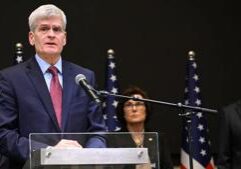
Joining the voices of Democrats calling the generous peace agreement “a humiliation,” U.S. Sen. Bill Cassidy, R-La., dubbed it “the worst foreign policy blunder in decades.”
“Iran’s nuclear ambitions were not curbed, and they have learned that threatening the Strait of Hormuz works and will undoubtedly leverage it in the future. Now, Iran gets to build brand-new infrastructure under this deal,” Cassidy fumed on social media.
“Before the war, the strait was open, Iran was being crushed by sanctions, and 13 service members were still alive. Now, 13 Americans are dead, families have paid billions at the pump, sanctions will be lifted, and the bombing has stopped.”
Though Cassidy’s criticism was expected due to his and Trump’s antagonistic relationship, other Republicans have chimed in as well.
Notably, Senate Armed Services Committee Chair Roger Wicker, R-Miss., issued a statement Thursday citing his concerns that the agreement “negotiates away the victories of Operation Epic Fury in ways that are completely out of step with the President’s goals.”
“Specifically, the $300 billion fund for the reconstruction and economic development of Iran – though not funded by U.S. taxpayers – would make Iran’s payoff under President [Barack] Obama’s 2015 deal look like a pittance by comparison,” Wicker wrote.
“I also oppose the U.S. lifting any sanctions on Iran, or unfreezing Iranian funds, in exchange for Iran’s mere agreement to negotiate for another 60 days. The Iranian regime has not renounced its ultimate goal — ‘Death to America, Death to Israel.’ The regime will invest every penny it receives to further that aim.”
Rep. Chip Roy, R-Texas, also expressed doubts Thursday about the deal, particularly the economic benefits it gives Iran.
“The Commander-in-Chief gets deference to defend America, in Iran or otherwise – & we’ve given it. But you cannot trust Iran, and deal or no deal, America must not financially prop up an evil terroristic state who wants to kill us – with either public OR private money,” Roy posted on social media platform X.
Other Republicans, however, are projecting cautious optimism, including defense hawk Sen. Lindsey Graham, R-S.C., following a discussion he had with administrative officials.
“Whether or not the United States can reach an acceptable, verifiable deal with Iran regarding its nuclear program and other issues is yet to be determined, but I see little downside to trying,” Graham stated. “The economic stability that comes from opening up the Strait and the cessation of hostilities could create a pathway to peace well beyond the Iranian conflict.”
Given that expanding the Abraham Accords and normalizing relations between Saudi Arabia and Israel is Trump’s “ultimate goal,” Graham added, “I think that is best achieved by creating economic stability for the United States, the region and the world, as well as the cessation of hostilities. The signing of the MOU is an essential step to make that happen and thus it is worthwhile.”
Since the initial joint U.S.-Israeli strikes launched against Iran on Feb. 28, global trade has seen disruptions and increased costs.
At least 13 U.S. servicemembers have died in the conflict, which currently carries a more than $30 billion price tag, according to House Armed Services Committee Chairman Mike Rogers, R-Ala.
That number is likely an undercount since the Pentagon doesn’t include spending on military construction costs of repairing or replacing U.S. installations in Iran.
The agreement comes as half of American voters support the U.S. pursuing diplomacy with Iran rather than further military action, per The Center Square’s most recent Voters’ Voice Poll, which surveyed 2,585 registered voters nationally June 1-4.




Sunny
Latest News Stories

P&Z Commission: New Women’s Recovery Center Proposed for Patterson Road Receives Support

WATCH: ‘Unfortunate accident’: Miss. senator blasted for comment on Guard troop shootings
WATCH: House Homeland Security hearing filled with tense exchanges

Judge rules against Trump’s freeze on wind energy

Illinois’ new paint fee takes effect, with critics calling it another burden on taxpayers
Pritzker decision looms for energy bill ‘on ratepayers’ backs’
WATCH: Use of National Guard debated in U.S. Senate as Illinois case lingers

Illinois quick hits: Senator’s deferred prosecution deal approved; Indiana Senate votes against new maps

Suspect in Charlie Kirk assassination makes first in-person appearance in court

Pro-life orgs call out FDA, Makary for not fulfilling promise to review abortion drug

Bill to extend enhanced Obamacare subsidies dies in Senate

Judge: CHA lawyers must pay $59K for citing ChatGPT-created cases