Kennedy nutrition pledge lacks enforcement as health costs rise
The federal government is spending $5 million on a voluntary medical school nutrition initiative, but fewer than 40% of the nation’s 202 accredited medical schools have signed on.
The Department of Health and Human Services and the Department of Education announced that 73 schools have pledged to require at least 40 hours of nutrition education across four years of medical school beginning in fall 2026.
The initiative carries no enforcement mechanism, and schools that fail to meet their pledges will face no penalties.
Federal spending on Medicare, Medicaid and related health programs is projected to increase from $1.9 trillion in 2026 to $3.1 trillion in 2036, according to the Congressional Budget Office’s February 2026 Budget and Economic Outlook.
The Committee for a Responsible Federal Budget, a nonpartisan fiscal watchdog, estimates federal health program spending has increased 80% over the past decade and will grow another 63% by 2036. CBO attributes that growth to an aging population and rising per-beneficiary health costs.
HHS launched a $2.1 million National Institutes of Health challenge grant as the first phase of a $5 million initiative to help institutions develop coursework, clinical training and research in nutrition science. Remaining funding will support nursing programs, residency programs and dietitian programs in subsequent phases.
HHS did not identify the budget line funding the initiative, has not published benchmarks to measure its success and did not respond to questions about when it would project cost savings.
Medical students reported receiving an average of 1.2 hours of formal nutrition education each year, according to a survey conducted in 2022 and published in the Journal of Wellness.
“We’ve let the medical schools be the adults in the room,” said Sam Waters, a counselor in HHS Secretary Robert F. Kennedy Jr.’s immediate office.
Dr. Jessica Snowden, vice chancellor for research at the University of Tennessee Health Sciences Center, one of the 73 signing schools, said nutrition is central to patient care.
“Nutrition is not a side issue in healthcare,” Snowden said. “It’s fundamental to many of the things that we need to have a healthy lifespan.”
More than 120 accredited U.S. medical schools have not signed the pledge, including Harvard, Johns Hopkins, Stanford, Columbia and Yale, according to directories maintained by the Liaison Committee on Medical Education and the American Association of Colleges of Osteopathic Medicine.
Harvard Medical School told The Center Square it has been expanding nutrition education since 2019 and is developing additional competencies, but did not say whether it considered and declined to sign the pledge.
Johns Hopkins and Stanford did not respond to requests for comment.
Eight major accrediting and testing organizations voluntarily committed to incorporating nutrition into physician training and licensing standards, including the Accreditation Council for Graduate Medical Education, the National Board of Medical Examiners and the Liaison Committee on Medical Education.
The National Board of Medical Examiners said about 15% of the United States Medical Licensing Examination sequence will assess nutrition-related knowledge, following enhancements to nutrition content announced in April across all three steps of the exam.
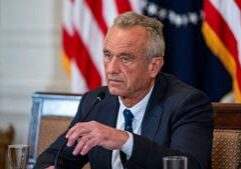
Kennedy said Monday the country “cannot solve the chronic disease burden without addressing nutrition.”
“We spend about 48 cents out of every federal dollar that Americans pay in taxes on healthcare,” Kennedy said.
Kennedy did not identify a source for the figure. A 2019 opinion piece by Dr. Marty Makary, then a Johns Hopkins professor who later served as Kennedy’s FDA Commissioner before leaving the post in May 2026.
Makary estimated that 48% of federal spending goes to what he called the “medical-industrial complex,” a broader category that includes pharmaceutical companies, medical device manufacturers and other health industries not captured in standard federal budget accounting.
Independent budget analyses using standard federal budget definitions put the figure lower. KFF, a nonpartisan health policy research organization, estimates federal health spending accounts for about 27 cents of every federal dollar. The Center on Budget and Policy Priorities, citing Congressional Budget Office data, puts the figure at 24 cents when counting Medicare, Medicaid, the Children’s Health Insurance Program and Affordable Care Act subsidies.
HHS did not answer questions about the methodology behind Kennedy’s spending claim.
The National Board of Medical Examiners did not respond to questions about whether its commitment to assess nutrition on licensing exams is binding or voluntary.
In a statement, HHS said the initiative aims to “reduce the growing financial burden of chronic disease on taxpayers.”
Kennedy has said nutrition education is central to reversing what he calls the chronic disease epidemic driving federal health costs.
“We’re training future physicians to address the root causes of diseases, not simply manage their consequences,” Kennedy said.





Mostly Sunny then Slight Chance Showers And Thunderstorms
Latest News Stories
Will County to Launch New Public Meeting Agenda System in August Amidst Data Conversion Concerns
Green Garden Township Poised for First Major Subdivision in Years After Rezoning
County RNG Facility Shows Strong Performance Despite Solar Challenges

PZC Briefs: Solar Farm in Crete, Post-Fire Permit for Troy Business, and More
In Brief: Capital & IT News
Will County Finance Committee July 1 Meeting Briefs
Will County Public Works Committee Juliy 1 Meeting Briefs

Prairie State College Braces for Potential Federal Cuts to TRIO Student Support Program
Prairie State College Showcases Booming Allied Health and Emergency Services Programs

JJC Trustees Approve Contentious FY26 Budget After Heated Debate, Failed Postponement
JJC’s ‘12x12x12’ Initiative Boosts College Credits, Increases Matriculation Rate
JJC Board Meeting Highlights Tensions Over Legal Bills, Trustee Conduct