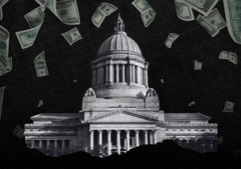
Report: U.S. added $1.2 trillion to national debt in six months
The U.S. government added $1.2 trillion to the national debt over the past six months, borrowing $163 billion during March alone, the Congressional Budget Office reports.
At the current rate of borrowing, federal deficits are on track to top $2 trillion by October, the end of the current fiscal year.
But the president’s recent budget request – which lawmakers will use as a blueprint for the 12 fiscal year 2027 appropriations bills – calls for $2.1 trillion in discretionary spending alone, without touching entitlement program spending.
“Both Congress and the President continue to ignore the urgent need to get our borrowing under control,” Maya MacGuineas, president of the Committee for a Responsible Federal Budget, said in a statement.
“As lawmakers consider the budget process for the upcoming fiscal year, we hope that they come up with plans to reduce deficits from the too-high 6% of GDP to a more sustainable 3% of GDP; secure our nation’s ailing trust funds for Social Security, Medicare, and highways; and ultimately fix the broken process that got us into this mess.”
Though CBO’s latest deficit estimate is $139 billion less than the amount recorded during the same time period last year, that is in large part due to increased tariff revenues and individual income or payroll taxes.
Federal spending, on the other hand, increased by $84 billion, mostly due to growing entitlement programs like Social Security, Medicare and Medicaid.
The government also collected 28% less in taxes from U.S. corporations over the last six months due to Republicans’ budget reconciliation bill – the “One Big Beautiful Bill” – which expanded deductions for certain corporate investments.
Yet despite repeated warnings from budget watchdogs, congressional action on soaring federal deficits and the over $39 trillion national debt ultimately hasn’t progressed past vigorous handwaving from a small group of Republicans.
Although the OBBB reduced federal spending by roughly $1 trillion over the next decade via entitlement program reforms, the savings only offset about a third of the bill’s $3.4 trillion ten-year cost.
Congress then sidestepped the automatic spending cuts to Medicare and other programs that are triggered by unpaid-for federal borrowing by wiping the Pay-As-You-Go (PAYGO) scorecard in November.
As House lawmakers return next week to begin hashing out appropriations funding and a second budget reconciliation bill, CRFB, the Cato Institute, and other budget watchdog groups are urging them to find at least $600 billion in savings.





Sunny
Latest News Stories
IL House Speaker: ‘not even close’ to school choice legislation

IL comptroller: Chicago mayor’s policies chase businesses away
Menards settles deceptive 11% rebate lawsuit for $4.25M with 10 states

Pace Expands I-55 Service and Launches ‘VanGo’ in Joliet

Will County Executive Committee Rejects School Choice Advisory Referendum
Frankie’s Pizza Celebrated for 42 Years of Business in Monee
‘Welcome Move’: 815 Mulch-It Granted More Time to Relocate in Homer Glen

Meeting Summary and Briefs: Public Works & Transportation Committee for December 2, 2025
Land Use & Development Committee forwards Women’s Residential Recovery Center
Will County Board Members Question Fairness of New Transit Tax Structure
Iroquois Paving Expands Operations; Tractor Supply Eyeing Spring Opening
Congress drags on full year funding bills, risking second govt shutdown