NIH plots investments in women’s health
The National Institutes of Health plan to award grants to medical school’s for educational programs on menopause.
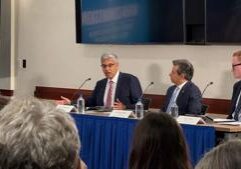
Leaders at the NIH announced a competition for prize grants on Thursday at the U.S. Department of Health and Human Services’ National Conference on Women’s Health. Director of NIH Jay Bhattacharya and Deputy Director Nichole Kleinstreuer, admitted the research facility has lagged behind on women’s health research.
“Now, the next generation of medical students will have a real rigorous curriculum,” Bhattacharya said. “Your doctors and your health providers will have good guidance to give to women as they go through this very normal stage of life.”
The two explained that common health indicators are drastically different for men and women, especially those for a heart attack. For women, heart attack indicators can include back pain, nausea and lightheadedness. Kleinsteuer estimated the NIH has invested more than $500 million into research and education of heart attack symptoms and diagnosis.
“I think that has spurred a lot of innovation in this space, but obviously more work is needed,” Kleinstreuer said.
Bhattacharya and Kleinstreuer also called for more funding toward research of autoimmune diseases. They said NIH needed to develop tailored therapies for people who struggle with autoimmune disorders.
They pointed to some breakthroughs in Alzheimer’s research and treatments of the debilitating memory loss condition. Bhattacharya said more funding for research can help solve some of these health problems and lead to greater overall prosperity.
“We can make America healthy again and solve the budget deficit in one go,” Bhattacharya said.
NIH is looking to get as many as one million participants in a survey for whole genome sequencing to study and conduct advance research in genetic diseases.
“Often our diseases have some genetic susceptibility at heart,” Bhattacharya said. “It’s both genes and the environment together that matter for human health.”
NIH has also implemented more research over whether hormone therapy is appropriate for women as they go through menopause. Studies have found the therapy is helpful to prevent chronic diseases after menopause and to keep women healthy.
Bhattacharya said menopause health has long been discarded based on little evidence. He called for greater replication of studies before issuing policies and procedures to follow.
“Really be rigorous in trying to get what are the most robust and reliable conclusions that can inform the better standards of care,” Bhattacharya said.
“It’s actually a fairly innovative concept for us to be really emphasizing replication as the foundation of gold standard science and rigorous advances,” Kleinstreuer said.
Bhattacharya called for greater unity among the scientific community and a deeper understanding of the issues those suffering with chronic illnesses face.
“We need to open the minds of scientists, allow scientists to disagree with each other, to check each others work in a collegial way so that we can end up with the best scientific ideas validated with a gold standard of science, addressing key problems in women’s health,” Bhattacharya said.






Sunny
Latest News Stories

Green Garden Township’s Wildflower Farm Granted Third Extension for Rural Events Permit

Will County Lowers Cedar Road Speed Limit Amid Debate Over Curve Safety and Fatalities

Nine Will County Municipalities Face Expired License Plate Reader Agreements; Crest Hill Opts Out

Judge Orders Will County Board to Approve Previously Denied Solar Farm Permits

Jackson’s Five RBIs, Covington’s Homer Power Kankakee Softball Past Crete-Monee in 16-13 Slugfest

Explosive Third Inning, Relentless Baserunning Propel Crete-Monee Past Kankakee, 19-9
WATCH: California probe ends $267M in alleged hospice fraud

Ex-Blago attorney: Quid pro quo is key to Madigan appeal

Illinois Quick Hits: House GOP says no Bears deal without property tax reform

WATCH: More than $600 million stolen from SNAP in 2025

Melania Trump denies any relationship with Jeffrey Epstein

War Powers Resolution halting Trump’s Iran ambitions fails in U.S. House