EXCLUSIVE: Inside one Michigan town’s fight against solar expansion
In Fayette Township in southwest Michigan, a series of utility-scale solar projects has drawn hundreds of residents to local meetings and sparked a grassroots campaign opposing the development.
Ranger Power, which currently runs Heartwood Solar I, is hoping Heartwood Solar II and Heartwood Solar III will expand solar development onto hundreds more acres of farmland across Hillsdale County.
The controversy highlights the growing tension between Michigan’s statewide clean energy mandates and the communities expected to host the projects that advocates say are needed to meet them. (Read the first installment of this series HERE.)
When Solar Comes Knocking
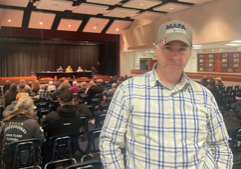
A knock on the door changed everything, Stephen Oleszkowicz told The Center Square in an exclusive interview. That was when a Ranger Power representative handed his in-laws a flyer about a solar project planned to border their land.
“We were not notified at all about this project from the township,” Oleszkowicz said. “We found out when Ranger Power knocked on my in-laws’ door and handed them a flyer talking about solar being on the property right next to them.”
With the news delivered the week before Thanksgiving, Oleszkowicz and his wife, along with neighbors, began organizing immediately.
“We all pitched our money in together to do a mailing. And we mailed out Christmas card-looking flyers that have a melting snowman on the front with a field of solar panels in the background,” Oleszkowicz said. “We sent it out to try to get people to come to the December meeting, which was in two weeks at that time.”
That first meeting, there were just a handful of residents, but interest grew quickly.
Oleszkowicz built a website over the Thanksgiving weekend to share information and coordinate efforts against the project. By January, more than 200 residents showed up at a rescheduled township meeting, forcing officials to move the gathering to a larger venue.
“We were hammering the internet, calling neighbors, doing whatever we could to let people know what was going on,” Oleszkowicz said.
An Uphill Battle
Oleszkowicz described township meetings regarding the solar development’s expansion as chaotic and confusing, leaving residents scrambling to make their voices heard.
“When we went to the December meeting . . . the township supervisor argued his point that there’s nothing we can do; it’s going to happen anyways,” Oleszkowicz said. “I tried to explain to them from my research, that’s not the case. There’s a way to fight this.”
He said residents quickly realized that even basic information about the project was often being withheld.
“We asked them specifically during public comment if anything had been submitted, and they said no,” Oleszkowicz said. “And then I found out from the minutes three weeks later that it [the map of the planned solar project] had been submitted in October to the planning commission.”
Oleszkowicz said this situation has made him realize that Fayette Township is not the only community experiencing this. Once he started taking steps to organize the community, Oleszkowicz began hearing from Michiganders all over the state in similar positions.
“It has been overwhelming the sheer number of people reaching out and places where this same stuff is going on,” he explained. “Rangers is not the only company out there doing it, but they are doing it all over.”
Oleszkowicz remains hopeful though, especially seeing how his community has come together over this issue.
“I’ve made a lot of new friends in this, as well as a lot of strange bedfellows,” he explained. “We have people from all ends of the spectrum and everywhere in between, from judges to lawyers to college professors to business owners to retirees.”
The Downsides to Solar
For Oleszkowicz, this project isn’t just a policy debate – it has a direct impact on his family and their future. Though Heartwood Solar found “no impact on adjacent residential property values,” property owners near these projects disagree.
“My property value alone is going to take close to a $100,000 hit,” Oleszkowicz said. “The buyer markets shrivel up, and the property values go down if I ever need to sell. So that’s stealing equity from my family in order to give a small payout to seven families for Heartwood.”
Reflecting on the stakes involved, he said simply:
“I don’t have a choice. They’re stealing my future from my kids.”
He emphasized that he has never been anti-solar, but drew a firm line when it comes to farmland.
“I’ve actually had a hobbyist interest in solar,” he explained. “It has its place, and that’s on a rooftop. It doesn’t have its place in our farm fields.”
Oleszkowicz warned that these industrial-scale projects can have a cascading effect.
“It’s far beyond just a little localized thing. When they bring in solar like this, and they stabilize and enhance the grid to this effect, what surely follows is . . . battery storage . . . then data centers,” Oleszkowicz said. “It’s all a cascading effect.”
He explained how these ever-expanding projects can have a massive impact on small, rural communities.
“When you look at a township the size of Fayette, we have roughly 13,000 acres in the township. There’s roughly 1,300 acres enrolled in the entire project on Heartwood I,” Oleszkowicz explained. “Now, they are asking for another 1,350. That’s 20% of our township right there.”
A Wider Debate Over Solar
While Fayette residents wrestle with local implications, Michigan is pushing ambitious statewide renewable energy goals. In 2023, Gov. Gretchen Whitmer and Democratic lawmakers passed legislation requiring utilities to generate 80% of electricity from clean sources by 2035 and 100% by 2040.
Rep. Jennifer Wortz, R-Quincy, represents Fayette Township as part of her district in the state House. She spoke with The Center Square in an exclusive interview. Wortz warned that subsidies and incentives, while intended to promote renewable energy, lead to companies disproportionately targeting rural communities with these projects.
“These are large corporations coming in because they’ve gotten large federal kickbacks and state tax incentives to do so,” Wortz said. “We are more of a target because we’re labeled a poor, economically-depressed community.”
Additionally, local governments are also receiving massive incentives to bring in these projects. According to a June 2025 press release from the Michigan Department of Environment, Great Lakes, and Energy, Fayette Township received $675,000 for the Heartwood Solar project as part of the Renewables Ready Communities Award program.
First funded in 2024, the program has paid out $26.1 million to 48 local governments for community improvements to incentivize “communities to host large-scale renewable energy projects.”
Wortz is continuing to work with townships in her district to inform them of their options, though limited, to address these large-scale projects.
Supporters of solar energy argue that projects like Heartwood Solar can provide economic opportunities while helping Michigan meet clean energy targets. In the case of Heartwood Solar, it is a $150 million investment that is projected to generate over $2 million in tax revenue in the first year alone. It is also expected to create between two and four permanent solar operations jobs in Fayette Township.
State Rep. Ranjeev Puri, D-Canton, told The Center Square that Michigan utilities are transitioning toward renewable energy for many different reasons.
“Solar energy is an important piece to our clean energy future. We’re seeing more and more energy companies in Michigan and even around the country transitioning and expanding their renewable energy portfolios,” Puri said. “I don’t think they’re doing it just because . . . it’s the right thing to do, or even because of these mandates. I think it’s because it has shown to be an economically viable option that is going to help them improve their bottom line.”
Puri also highlighted benefits such as local construction jobs and state programs offering financial incentives to municipalities hosting renewable energy projects.
“In Michigan here we can make sure that our energy is going to be Michigan made, and that will ultimately lead to more reliability and lower costs and an improved grid,” he said.
Puri said he believes that many community fears about solar projects often stem from misinformation.
“I had a chance to see a lot of the misinformation campaigns,” Puri said. “You would see these pictures of solar arrays right up to the property line . . . and that’s just not the reality.”
According to Heartwood Solar, it is maintaining a minimum distance of 150 feet between all residences and solar arrays.
Looking Ahead
For Oleszkowicz and other Fayette residents, the fight is far from over. Even if the township board decides against the solar project’s expansion, Ranger Power is already preparing to take it to the Michigan Public Service Commission for their overriding approval.
For Oleszkowicz, staying involved isn’t optional. He stressed that vigilance and community engagement are key, especially as similar battles are unfolding across the state.
“Just get the word out there to as many people as you can,” he said. “It’s going on everywhere. We’re not the only ones. We’re not the first nor near the last.”
Check back for next week’s installment in this series, which will look at clean energy reliability, affordability, and the relationship between the Michigan Public Service Commission and local communities.






Partly Sunny then Chance Showers And Thunderstorms
Latest News Stories
County Board Approves 2026-2031 Transportation Plan Despite Project Opposition
Contentious I-3 Rezoning for DuPage Township Storage Yard Narrowly Advances

Will County Legislative Committee July 1 Meeting Briefs
County Moves Forward with $200.8 Million Bond Refinancing Plan
Access Will County Dial-a-Ride Program Sees Record Growth, Eyes Expansion
Will County to Launch New Public Meeting Agenda System in August Amidst Data Conversion Concerns
Green Garden Township Poised for First Major Subdivision in Years After Rezoning
County RNG Facility Shows Strong Performance Despite Solar Challenges
PZC Briefs: Solar Farm in Crete, Post-Fire Permit for Troy Business, and More
In Brief: Capital & IT News
Will County Finance Committee July 1 Meeting Briefs
Will County Public Works Committee Juliy 1 Meeting Briefs

Prairie State College Braces for Potential Federal Cuts to TRIO Student Support Program