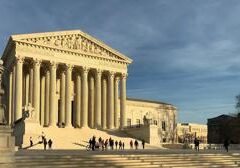
Supreme Court strikes down court error in baby food case
The U.S. Supreme Court, in a unanimous decision, struck down a lower court’s decision preventing parents from suing a baby food manufacturer over tainted products.
The case, Hain Celestial Group v. Palmquist, centers around parents in Texas who fed their child baby food from Whole Foods Market. Later, their child was diagnosed with mental and physical conditions resulting from heavy-metal poisoning.
A report later found that baby foods, including Hain’s, contained elevated levels of toxic metals. Sarah and Grant Palmquist, the Texas parents, sued Hain and Whole Foods in state court.
Hain, a company based in Delaware, removed the case to federal court. U.S. law allows federal courts to handle disputes likely exceeding $75,000 in damages when it is between entities in different states. However, Whole Foods was based in Texas and gave the Palmquist’s standing to keep the lawsuit in state court.
“The Palmquists exercised their right to choose a state forum by purposefully and properly joining a nondiverse defendant against whom they could not proceed in federal court, and diligently asserted that right by promptly moving to remand the case to state court,” Justice Sonia Sotomayor wrote in the court’s opinion.
Justice Clarence Thomas filed a concurring opinion in support of Sotomayor’s opinion. He pointed to the court’s historical interpretation of claims in state and federal courts.
“This Court has always interpreted §1332(a)’s language ‘to require ‘complete diversity,’ meaning that a federal court can exercise jurisdiction only if no plaintiff shares state citizenship with any defendant,” Thomas wrote.
Thomas also called on the high court to revisit the ‘improper-joinder doctrine,’ which allows federal courts to disregard the citizenship of plaintiffs in cases where there is a lack of diversity.
“Federal courts sitting in diversity likely cannot dismiss nondiverse parties based on their view of the merits of the claims against those parties,” Thomas wrote. “Doing so appears unfaithful to Congress’s limits on our diversity jurisdiction and inconsistent with this Court’s precedents.”
If the court were to revisit this precedent, it could fundamentally alter high profile lawsuits across state lines. This could put national companies at risk for large financial burdens similar to this baby food case.





Sunny
Latest News Stories

IL House GOP asks “Have you had enough yet” following student’s murder

EXCLUSIVE: 5-year anniversary of Operation Lone Star, nearly 540,000 apprehended
Many Republicans say proposed bipartisan DHS funding deal ‘impossible’

Mullin sworn in as secretary of Homeland Security

Gas spike continues for Illinoisans; state leaders offer no plan to help yet

BREAKING: Minnesota sues feds for evidence in Metro Surge shootings

Supreme Court appears to favor Trump’s asylum border policy

Updated: St. John Woman Charged with Nine Counts of Murder in Crete Township Triple Homicide

NASA plans to build $20 billion base on the Moon

HUD launches investigation into race-based Washington housing program

Illinois lagging the nation for entrepreneurship, economic growth

Illinois Quick Hits: Iowa PA license wait times half of Illinois

Will County Previews ‘GuideWill’ Comprehensive Resource Management Plan

Peotone Library Board Rescinds Prior Decision, Returns to Werner’s Landscaping