
Illinois millionaire’s tax would direct 50% of revenue to public schools
(The Center Square) – A proposal for a state constitutional amendment to impose a millionaire’s tax has been referred to the Illinois House Rules Committee, but only half the revenues generated by the measure would be directed to property tax relief.
House Joint Resolution Constitutional Amendment 21 was referred to the committee earlier after being filed by state Rep. Natalie Manley, D-Joliet, last October.
The measure would impose a 3% tax on any individual’s net income that is greater than $1 million for the taxable year.
Former Gov. Pat Quinn promised last November that a millionaire’s tax would bring property tax relief for families and businesses, but House Joint Resolution Constitutional Amendment 21 would split the revenue.
Half would go for property tax relief, and the other half would go to school districts on a per-pupil basis.
The Chicago Teachers Union and Illinois Federation of Teachers have pushed for state-level “Tax the Rich” policies.
Republican Illinois House candidate Lori Smith said she hoped any new tax would not include pensions, adding that her mother is a retired educator.
“She won’t leave this state because they don’t tax her pension. I said to her the other day, ‘Mom, do you realize that they’re coming after it now?’” Smith told The Center Square.
Smith said one positive thing she could say about Illinois is that the state does not tax teacher pensions.
Smith is running for the 51st Illinois House seat currently held by state Rep. Nabeela Syed, D-Palatine, who is running for the Illinois Senate.
Smith cited taxes as one reason she decided to run for office.
“For me, this is not about party. It’s about the people being crushed to death by taxes and regulations. Somebody has to do something,” Smith said.
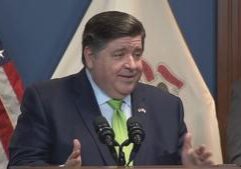
Gov. J.B. Pritzker expressed support for the idea of a graduated income tax when he spoke in Chicago earlier this month.
“I think that, to pay the bills of the state of Illinois, it’s fairer if the wealthiest people in the state, the wealthiest corporations in the state, pay more than average folks, working folks and the most vulnerable,” Pritzker said.
Illinois state spending has increased 43% under Pritzker, an increase of $16 billion annually since 2019.
The governor noted that a constitutional amendment is not something he would sign but instead would be handled by the legislature.
If the legislature approves HJRCA 21, voters would have the chance to consider the proposed amendment in the November 2026 general election.
State Rep. Brad Halbrook, R-Shelbyville, said a graduated income tax proposal would be another attempt to force through what voters already rejected.
“After watching families pack up and leave, after watching thousands of businesses leave, after losing nearly 100,000 people in just one year, the answer from leadership and our speaker is the same old answer: tax more,” Halbrook said on the House floor last week.
In 2020, voters rejected a proposal changing the state’s flat tax to a tax with higher rates for higher earners.
Greg Bishop contributed to this story.





Chance Showers And Thunderstorms then Showers And Thunderstorms Likely
Latest News Stories

Will County Public Health & Safety Committee July 3 Meeting Briefs
Prairie State College Board Accepts Positive FY2024 Financial Audit
Will County Seeks Asian Carp Provision in Federal Legislative Agenda
State Legislative Session Update: Transit, Energy Bills Stall Despite Democratic Control
Will County’s Major Capital Projects Hit Key Milestones, VAC Buildout on “Aggressive Schedule”
County Board Approves 2026-2031 Transportation Plan Despite Project Opposition
Contentious I-3 Rezoning for DuPage Township Storage Yard Narrowly Advances
Will County Legislative Committee July 1 Meeting Briefs
County Moves Forward with $200.8 Million Bond Refinancing Plan
Access Will County Dial-a-Ride Program Sees Record Growth, Eyes Expansion
Will County to Launch New Public Meeting Agenda System in August Amidst Data Conversion Concerns
Green Garden Township Poised for First Major Subdivision in Years After Rezoning