One year in: Reviewing Trump’s inaugural promises
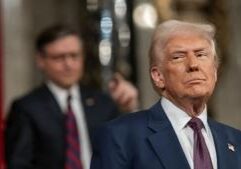
One year ago Tuesday, President Donald Trump told the nation its “golden age” had arrived, promising to spend his second term restoring stability at home and abroad through deportations, tariffs, and cutting government waste.
“For American citizens, January 20th, 2025, is Liberation Day,” he said during his inaugural address inside the U.S. Capitol. “It is my hope that our recent presidential election will be remembered as the greatest and most consequential election in the history of our country.”
After 365 days and 225 executive orders, where does progress stand on some of the president’s more notable priorities?
Border security and immigration
On his first day in office, Trump issued a series of border security orders “to protect America from invasion.” He was the first president in U.S. history to declare an invasion at the southwest border, The Center Square reported.
“All illegal entry will immediately be halted, and we will begin the process of returning millions and millions of criminal aliens back to the places from which they came,” Trump said.
The U.S. Department of Homeland Security reported millions of immigrants have either been deported or self-deported since Trump took office.
In March, Trump instituted the Alien Enemies Act of 1798 to go after alleged members of Tren de Aragua, after he’d designated the Venezuelan transnational criminal organization a Foreign Terrorist Organization. Within ten months, hundreds of alleged TdA members had been indicted nationwide, The Center Square reported.
“[Tren de Aragua] has engaged in and continues to engage in mass illegal migration to the United States to further its objectives of harming United States citizens, undermining public safety, and supporting the Maduro regime’s goal of destabilizing democratic nations in the Americas, including the United States,” Trump wrote in the March executive order.
The order has led to several military strikes on alleged drug boats and the capture of Venezuelan leader Nicolas Maduro.
“As commander in chief, I have no higher responsibility than to defend our country from threats and invasions, and that is exactly what I am going to do. We will do it at a level that nobody has ever seen before,” Trump said.
Energy
During his address, Trump also said he would declare a national energy emergency and use deregulation to open pathways for increased oil and gas production.
Since his address, the Environmental Protection Agency, Transportation Department and other federal agencies have reduced regulations for companies to procure more oil and gas.
Transportation Secretary Sean Duffy estimated that deregulation from his agency alone would save $600 million.
The Trump administration also revoked electric vehicle standards, particularly in California.
“We will build automobiles in America again at a rate that nobody could have dreamt possible just a few years ago,” Trump said.
Trade
President Trump also began to roll out his trade policies with foreign nations during his inaugural address.
“Instead of taxing our citizens to enrich other countries, we will tariff and tax foreign countries to enrich our citizens,” Trump said.
The administration quickly established the External Revenue Service to collect tariffs and other foreign revenues. Trump used powers under the International Emergency Economic Powers Act to implement his desired tariff rates.
He also announced tariffs on specific goods, no matter where they came from. This included a 25% tariff on foreign-made cars and 50% for steel and aluminum.
Several businesses quickly challenged Trump’s authority to issue tariffs under the Emergency Economic Powers Act. He has repeatedly begged for a favorable ruling from the court’s justices.
“The TARIFFS are responsible for the GREAT USA Economic Numbers JUST ANNOUNCED…AND THEY WILL ONLY GET BETTER!” Trump wrote in a social media post. “Also, NO INFLATION & GREAT NATIONAL SECURITY. Pray for the U.S. Supreme Court!!!”
Federal Workforce
Trump’s inaugural address also formally introduced the Department of Government Efficiency, an agency designed to root out “waste, fraud and abuse” in the federal government. The agency spearheaded mass firings, with some estimates suggesting around 300,000 federal workers were laid off.
As of January 2026, the department, often called DOGE, estimated that it has saved $215 billion in mass layoffs and the elimination of grant funds across.
“President Trump created the Department of Government Efficiency (DOGE) to bring accountability and transparency to federal spending, ensuring taxpayer dollars are spent wisely and effectively — and it has already saved taxpayers billions of dollars,” the White House said.
DEI
Trump also promised to end federal policies that “socially engineer race and gender into every aspect of public and private life.”
Over the last several months, his administration has cut millions in federal grants for diversity, equity and inclusion projects. He has proposed eliminating a $315 million grant for early education facilities and $77 million for teacher training programs that included topics on critical race theory.
Trump has been affirmed along the way as he implements these cuts. In August, the U.S. Supreme Court rescinded an order from a Boston judge that blocked $783 million worth of cuts made by the National Institutes of Health on gender identity and diversity, equity and inclusion.
The high court’s majority said the lower court judge did not follow its spring decision allowing the Trump administration to cancel education grants.
“When this court issues a decision, it constitutes a precedent that commands respect in lower courts,” Justice Neil Gorsuch wrote.



Sunny
Latest News Stories
NIH plots investments in women’s health

Pritzker: ‘God was looking out for people’ in storm-damaged Kankakee County

Illinois Quick Hits: Correctional officer charged with sexual misconduct
24 AGs question funding of orgs refusing to remove climate agenda from judges manuals

Costco faces lawsuit as consumers seek refunds from invalid tariffs

Insurer won’t back Gori defense vs asbestos lawsuit fraud claims

With teachers union support, committee approves charter school mandates

Allstate can’t delete class action over alleged secret app tracking

Chicago voters view housing affordability as bigger issue than crime
New Illinois gun bill aims at glock switches; critics say it misses the real problem
Illinois quick hits: Cook County spends nearly $20 million on food, housing services; Chicago Teachers Union tells teachers, students to skip school; Russell Dickerson to play Du Quoin State Fair

Will County Officials Warn of Zoom Court Scam Targeting Defendants for Fraudulent Dismissal Fees